

Saying Good-bye to the Night

A ritual devised to meet the needs of a beloved aging dog had become a sacred nighttime gift.

I named my blog domain for a beloved Jack Russell terrier Sheila and I adopted. He grew old as he, Sheila and I journeyed life together for a decade or so. His name was Deacon. I blog at DrDeaconDog.com.

Sheila said Deacon was an apt companion for a liturgical theologian like me because he was devoted to rituals. Deacon was committed to “the way we do things every day,” from getting up at the precise getting-up hour to walking each morning without fail, to eating at the same time every day, to sitting together in our favorite chair at the appropriate time every evening.

As Deacon grew older, he needed more assistance with his last trip outdoors before going to bed. This required a change in our nightly bedtime ritual. Now, instead of sending Deacon out the backdoor into our fenced yard just before settling in to sleep, I suited him up with his harness and leash and walked with him up and down the sidewalk out front.

Much to my surprise Deacon embraced with his usual ritual fervor this change in our nighttime habit.

I was less enthusiastic.

“You’re a liturgist,” Sheila said when I complained about the new bedtime outings. “Can’t you turn this into a meaningful ritual? Maybe you can think of it as saying goodbye to the night. Don’t you liturgical theologians love that sort of thing?”

Sheila had a point. I began to consider how Deacon was teaching me to pay attention to the night. As I became more intentional about saying goodbye to each phase of the moon, a new orientation to the gifts of eventide seeped into my bones and recalibrated how I embraced the final hours of each day.

Over time as Deacon and I wandered up and down our neighborhood sidewalks, I began to reflect on the happenings of the day as I looked up into the expanse of a sometimes clear, sometimes muted, night sky. In spite of myself I began to experience wonder in my heart and in the soles of my feet—in the marrow of my bones.

A ritual devised to meet the needs of a beloved aging dog had become a sacred nighttime gift.
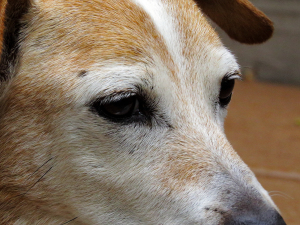
Photo of Deacon Dog by Jill Crainshaw

A nighttime goodbye chant began to emerge as autumn gave way to winter and our walks continued. I was surprised that as the chant emerged from the womb of the evening, its arc stretched from sunrise to sunset and across the human and canine life span.

I was also surprised to realize that the chant was the first poem I had ever written. It was a hymn of praise and petition lifted to an unexpected additional companion–a Holy Other—who met me and Deacon each night and walked alongside us.

When the sun lifts its head in the eastern sky,
And the birds begin to sing,
We give thanks, O God, for the dawning light,
And the symphony of hope it brings.

Fill my feet with the joy of the morning.
Tune each tendon to the sounds of your grace.
Let each step I take through the streets of the city
Be a note in this hymn of praise.

When we say our farewells to another day,
And the stars begin to shine,
We give thanks, O God, for the moon at night,
And its promises of rest sublime.

Fill my dreams with the hopes of tomorrow.
Lay me down to sleep and give my soul your peace.
Restore my hands; bless my feet; calm my restless thoughts.
May the worries of the day begin to cease.

When age takes its toll on my body
And my hands become feeble and frail,
I will lift them up to give thanks to you
And I’ll pray for the strength to sail

Over the river Jordan
Under your stars and your light.
Please guide my boat to the other shore
As I say goodbye to the night.

Note: A version of this post and the poem appears in my recent book, When I in Awesome Wonder: Liturgy Distilled from Everyday Life, Liturgical Press, 2018.
the writing work of the people

crafting poems, prayers, and litanies for worship

What does worship sound like? What ideas, hopes, dreams, and laments do the words of worship spark or stir or set loose in our hearts and minds? What images of God swirl up out of our communal prayers and hymns to shape what we believe and who we are as people of faith? Words are powerful. How we use words in worship matters.

At Wake Forest University School of Divinity, I teach a course entitled “Liturgical Writing as Spiritual, Theological, and Prophetic Act.” One aim of the course is to encourage students to become liturgical writers, in other words to craft prayers, poems, spoken word pieces, hymn texts, blessings, calls to worship, and more. The course also invites students to explore and name what theologies they are embodying through their choices of language, images, styles, and forms for public prayers and written liturgies. In the course, students learn about elements of worship and explore historic and contemporary examples of how words and linguistic patterns are used in liturgies. Students also share their own liturgical writing efforts each week in a writers’ workshop format. My primary hopes for the course? I want students to explore relationships between the historic and traditional voices of diverse liturgical forms, their unique voices and theologies, and their roles as public prophets, theologians, and spiritual leaders. I also hope that students will attend to elements of style that support vivid and effective liturgical communication: rhythms of public prayer, use of metaphor and imagery, how form and language create atmosphere in worship.

Sometimes students are reluctant to “write liturgies.” In some cases, that is because they come from traditions where most liturgical elements are already crafted for them in denominational worship books or in other resources. Other students come from traditions where writing liturgies is not a common practice. I invite all students to experiment with liturgical writing as a spiritual discipline that can spark greater awareness of their personal theological beliefs. Liturgical writing can also instill confidence in students about the vitality of their public voices as they prepare to become worship leaders.

As students in the course take their initial forays into writing liturgical elements, I encourage them to consider what I call “place-connected” dimensions of worship. What do I mean by this? The most important thing we can do when we craft prayers, hymns, and litanies is to let our liturgies arise as we are fully present to our surroundings and to the story that is unfolding in front of us in our communities–in our places.

Sometimes students request templates to help them frame their written work. I tend to avoid using templates and instead offer students basic information and guidance about the shape and purpose of various worship elements. I want students to explore what it means to be fully present in a pastoral moment and then consider how to express what they experience through extemporaneous and written prayers and other liturgical forms.

The work of hospital chaplains provides an example of the place-connected prayerfulness I hope to encourage in pastoral leaders. Chaplains are often asked to pray at the bedsides of patients. To think theologically on my feet and shape a prayer that arises from the soul of the moment means, for me, noticing everything and every person in the room. Is there a stuffed animal in the room–where did it come from? Who is present? What stories are people telling? Is it winter outside or springtime? What is outside the window? Even the shoes people are wearing can sometimes tell you something about the narrative arc and emotional center of the praying moment.

Having connected with all that is present in the moment (including what is present in the chaplain’s own heart and body), then the chaplain can focus on an image or metaphor and allow a prayer to arise with that image at the center. I find that this gives prayers emotional color and weight that make them memorable and powerful.

Today’s ministry students and pastoral leaders encounter on a daily basis a wide array of multi-denominational and multicultural religious contexts. Ministers are often asked not only to lead in public worship but also to offer prayers for a range of situations and occasions (over family meals, at public events, and for varied ritual occasions, such as commencements, house blessings, and church dinners). As they explore historical and traditional liturgical forms and resources and attempt to craft some of their own worship words, students learn much about the dynamic and often prophetic relationship between what we pray and what we believe.

Note: In collaboration with students in two versions of this course, I have published collections of their liturgical writing. Words Made Flesh: Poems and Prayers for Worship and Uncommon Words, Common Worship; Selected Prayers, Poems, and Laments. Both were published by Wake Forest University’s Library Partners Press.