
It is all too easy to understate and miss that hope is not intended to be an extraordinary infusion, but an abiding state of being. We lose sight of the invitation–and in fact, our responsibility, as stewards of creation–to develop a conscious and permanent connection to this wellspring. We miss the call to become a vessel, to be come a chalice into which this divine energy can pour; a lamp through which it can shine. . .
Cynthia Bourgeault, Mystical Hope: Trusting in the Mercy of God
This pandemic springtime has meant for me and Sheila more time to attend and tend to the flowers and other vegetation in our yard. The season has been more lush–with both flowers and weeds–than usual, and we have basked in nature’s backyard beauty even as we have missed venturing beyond our nest to spend time with friends and family members.
Against this backdrop–this strange mixture of pandemic uncertainties and dazzling buds and blossoms–Easter Day dawned. I remember thinking when I got up out of bed on Sunday–“what a peculiar Resurrection Day this is.”
Understatement? Yep.
But even as I write that, I picture that first Resurrection morning when Mary Magdalene came to the tomb and saw that the stone had been rolled away (Jn 20:1).
Talk about peculiar. Startling. Frightening. Overwhelming. Maybe even angering.
They have taken away my Lord, and I do not know where they have laid him.
John 1:13
Several thoughts come to mind for me as we journey–or is it as we wander–into the Fifty Days of Eastertide in the midst of a continuing coronavirus crisis.
Ongoing Resurrection
The resurrection of Jesus is never solely his story; we participate in it through our baptism and ongoing practices of resurrection.
Molly T. Marshall, “Ongoing Resurrection”
Resurrection is persistent. It never ends. It never gives up.
Easter Sunday each year is a trumpeting announcement of Resurrection. It is an emphatic proclamation of God’s grace and love alive in the story of Jesus.
Easter Sunday is also a moment in an arcing, spiraling, dancing, laughing, even sometimes weeping, never ceasing movement of Resurrection.
Jesus overcame the powers of death, and we participate in Jesus’ resurrection story through our baptisms and by saying “yes” as best we can–in faith–to the ongoing presence of resurrection in our everyday lives.
Flowers bloom in their seasons
Not all flowers bloom at the same time.
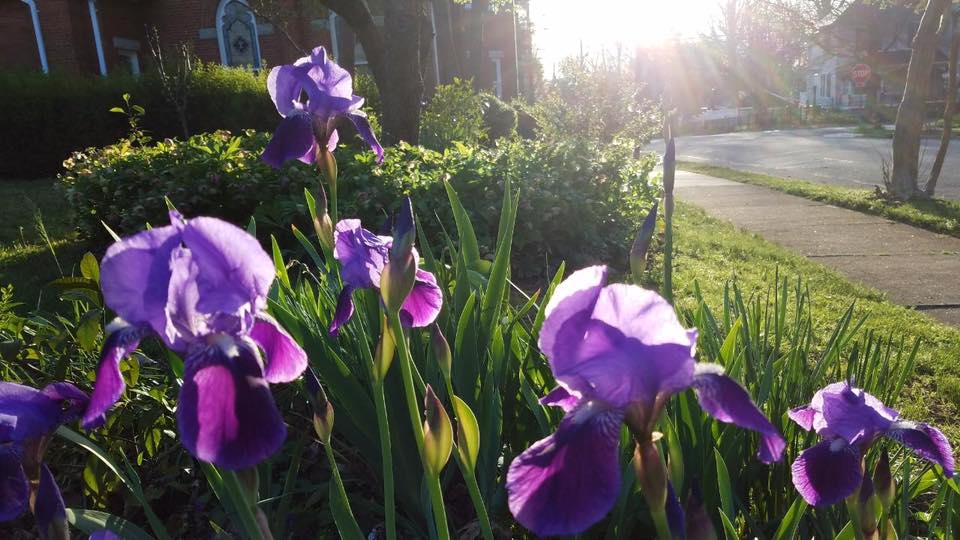
At least, that is true in our garden. Crocuses arrived first in our yard this spring. Then daffodils. And after that, our obligato tulip (we only have one tulip for some reason). Now, we are enjoying garden beds infused with a rainbow of irises.
What I am noticing in particular this spring is that our irises do not bloom all at once. Also, each iris blooms according to its own timetable, and each takes awhile to reach full blossom.
Blooming is a process.
I am more aware than ever this year that for me resurrection is a process. Or maybe I should say that our capacity to embrace resurrection is a process.
I come to the Garden alone
Jesus’ resurrection appearances in the Gospels are a reminder of this. Mary Magdalene didn’t recognize Jesus when she first saw him in the garden on Resurrection morning. Why should she have? Nothing in her history or her knowledge base prepared her to expect to see her crucified friend alive and well.
Instead, she assumed what her everyday reality told her was likely–that someone had stolen the body. And then she saw–or thought she saw–what was more common to her everyday experience. A gardener.
I wonder. What was it about his appearance that made her think he was a gardener? Something about his hands? Or the way he was walking along the garden path?
Whatever the reason, Mary’s recognition of Resurrection was not immediate. It dawned on her. Unfurled in her heart. Bloomed in her eyes.
“I have seen the Lord.”
The same was true for other friends of Jesus in those days after Easter dawned. The joy of Easter came to them–and not to all of them at once–in increments. Over a period of days. Or weeks. Or even longer, maybe even a lifetime.
Resurrection can happen that way in our lives too. Each of us experiences our life’s resurrections in our own way and often in our own time. That is an amazing gift of God’s grace to us. Resurrection catches us by surprise, sometimes when we least expect it and often when we most need it.
Resurrection rhizomes
For me in these times, a sustaining gift of Easter is that it is, in a sense, rhizomatic. Our irises this year sparked this thought.
What do I mean by a rhizomatic resurrection?
“Rhizome” comes from an ancient Greek word that means “mass of roots.”
A rhizome in plant life is a subterranean stem that shoots out roots from its nodes. Rhizomes grow horizontally and send out new stalks to grow up through the ground toward sunlight. That is why our irises offer a broader expanse of color in our yard each year. They multiply. They are rhizomatic.
Humans and human communities are connected like this too, in a way. Resurrection’s wellspring of grace infuses our spirits with life-giving nourishment and sends us out as new shoots to grow up and into the world, sharing the wonders of God’s love, justice, and hope with others.
We don’t all bloom into the fullness of resurrection at the same time, and that is okay. We have each other–a mass of entwined roots–to connect us to God’s Wellspring while God leads us, calls us, invites us, journeys with us into Easter light.
Yep. This is a peculiar Easter season. I pray that we encounter Resurrection as we can, here and there, in our life gardens. I also pray that we can tap into the deep-rooted Gospel promise that because of Jesus’ life, death, and resurrection, hope can be for us an abiding state of being that empowers and blesses us no matter where our journeys take us.
Resurrection Welcome

Oh, to be welcomed--

Like a maiden daffodil
braving old woman winter’s
last chance huffs and puffs

Like the first salted-sweat sip from
a freezer-frosted mug
on a frothy-hot day

Like the first gasp of a poem
surprising a scruffy scrap of
mead loose leaf college ruled

Like the last ox-eyed daisy petal
promising that she loves me--
loves me not—she loves me--

Like a gardener in a graveyard
planting iris promises
among the tombstones

 Salt: Seasoned Theology