
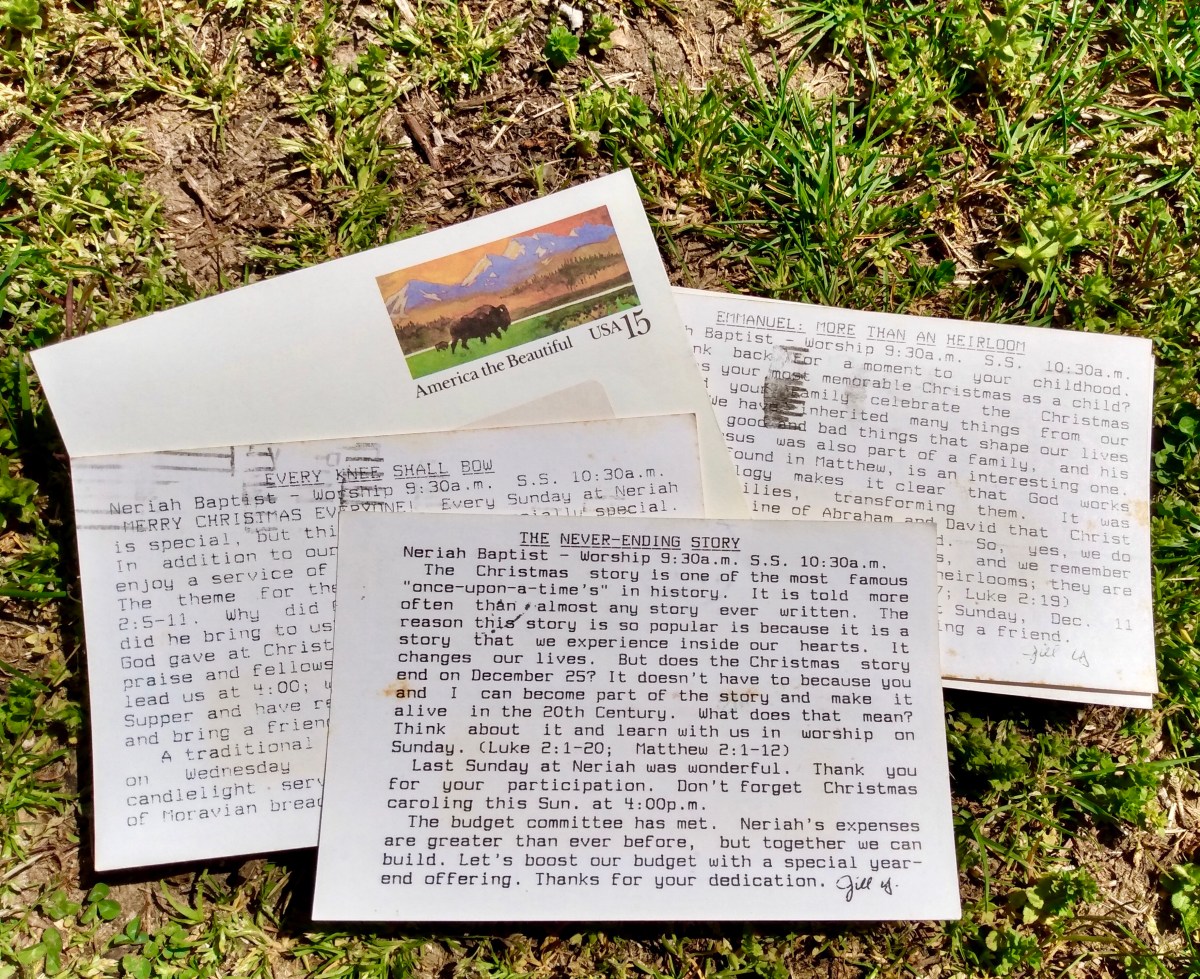
Being quarantined has caused me to rummage around in some dusty corners of my house and my mind. Today, I found a stack of old postcards from the days when I was the pastor of Neriah Baptist Church in the mountains of Virginia.
In 1990, before Facebook and blogs and Instagram, we connected with our church community between Sundays with postcards. I prototyped the card on my Smith-Corona electric typewriter. Then I took the prototype to the local print shop every Tuesday. By Wednesday, one hundred cards were printed (not digitally copied but printed) on postcard stock. A church member and I put labels on the cards and mailed them on Wednesday afternoons.
Times have changed—
—and not changed
Of course, the world has changed in big ways. I have too.
But reading those old postcards, I realize. Some core characteristics of my identity as a minister back then ring true to who I have become now. I am older. I hope I am wiser. But. . .
Here is an excerpt of what I wrote on a postcard all those years ago:
The bud of a tulip opening to the world--
arms of God,
cradling the gift of life.

Dew glistening on the morning trees--
teardrops of the Creator,
cleansing the earth of sorrow.

Grass fresh-cut on a spring day--
God's greenness
staining our shoes and spirits with hope.

A spider's web sparkling with diamonds
           after the coal of night is carved away--
the Great Weaver,
connecting our hearts to heaven.

Footprints of a deer along a dirt road--
our journeys toward God
and the impression we leave behind for others.

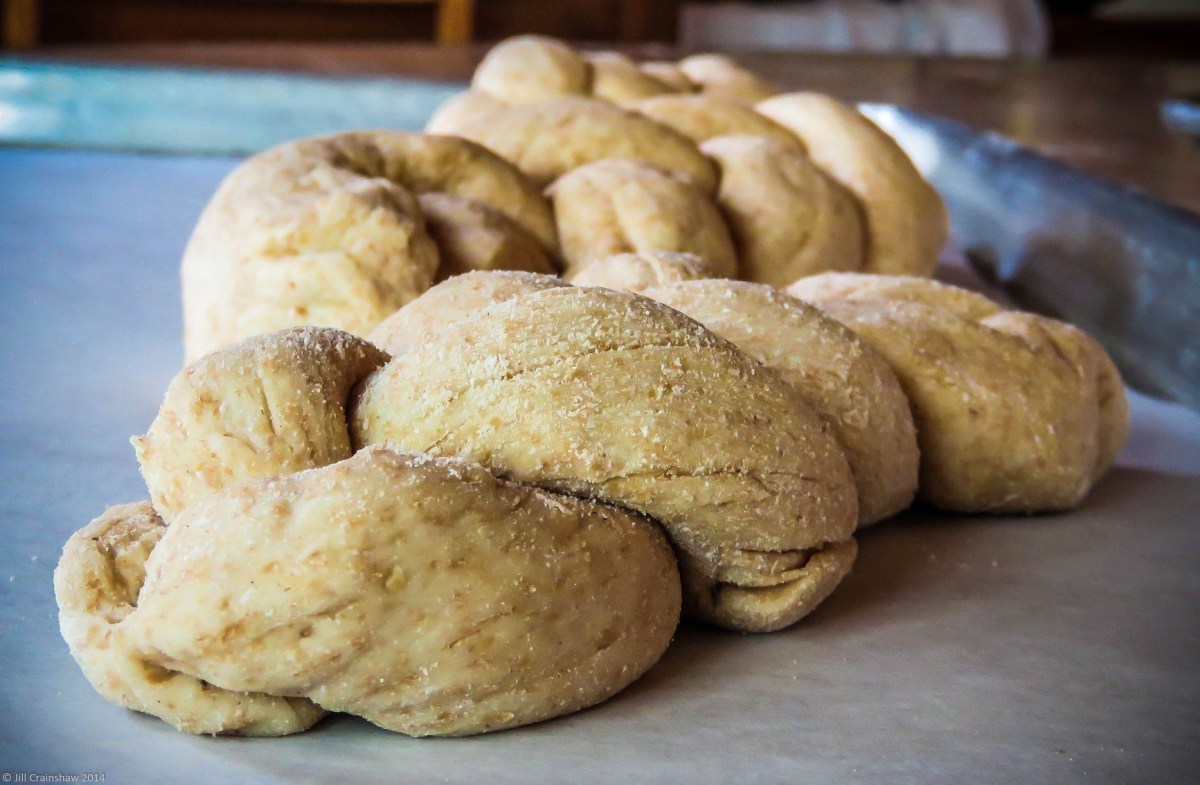
We stand in the midst of nourishment, and too many starve. Our souls long for the bread of life, for forgiveness from our mistakes. Our spirits yearn to grasp the stars, to see our dreams come true, and yet, we live in a world where too few are given second chances. Lives are shattered by pain. If only we could gather up the little things, the millions of pieces of living that make up the loaf we call the bread of life. If only we could come home to God’s love and find renewal, reunion, love.

Let us come to the table of the Lord.
Let us gather up the crumbs and live.
I did not format that 1990 postcard message as a poem. All of the words had to fit on a 3 ½ by 5 ½ card, and I did not consider myself to be writing poetry. These days I am intentional about learning the craft of poetry-writing. And I think–I hope–my theology and faith have deepened over the last 30 years (wow–30 years!).
Some things, though, have stayed steady across time and space—God’s presence and the promise that in life’s everyday stuff, in the places and people we encounter, we can find nourishment. We can find God’s grace and hope and renewal.
Remembering Holy Tuesday
Today is Holy Tuesday.
The lectionary Gospel text for this third day of Holy Week is John 12:20-26.
“We want to see Jesus.”
John 12
This phrase from the text stands out to me today.
In this story, some Greeks come to Philip and ask if they can see Jesus. The Gospel writer never tells us whether or not these seekers get to meet Jesus. Instead, the story shifts and Jesus begins to talk about his final hours of life and his impending death.
What happens? Do the Greeks encounter Jesus?
I wonder because of how urgent it seems sometimes that we see Jesus. That we are assured that God is with us.
The urgency has surfaced in my prayers and thoughts in recent weeks:
“Where is God in all of this?”
“Who are we as God’s people?”
We who in these days are looking into the face of human mortality want to know how this pandemic will end. Some of us are searching for meaning in the midst of the mess. Others seek healing and hope.
I—many of us—want to see God-with-us.
So we come to Holy Week 2020. The story of Holy Week in any year is a gritty story of Jesus’ journey to the cross. It is also a story of how those who journeyed with Jesus looked squarely into the reality of life at its end and caught sight of life at its most radical and robust aliveness. They did this in stumbling and imperfect ways. But they had the chance to see Jesus by facing into what it means to be human and what it means to be people who follow the life and teachings of Jesus even if the road is treacherous and could lead to death.
We have a chance during this Holy Week to stake stock of who we are and who we hope to be as people of faith. The world harbors many death-ways. COVID-19 is not the first threat to human well-being and will not be the last. Some in our neighborhoods and communities have already looked into death’s face because they already were and are wrestling with poverty, hunger, homelessness, sickness, economic injustices, violence, and other life-denying realities.
We join the seekers in today’s Gospel in crying out: “We want to see Jesus.”
Today’s response?
We see Jesus in each other, in the thousands of ways we are finding to care for each other through this crisis. We see Jesus in grocery store workers and health care providers, in workers who deliver groceries and teachers who teach through the storm, in mail carriers and pharmacists and bank tellers. We see Jesus through Zoom platforms and Facebook Live. We see Jesus in the smiles and waves of neighbors whose names we do not yet even know.
But it is more than that. We don’t just see Jesus. We encounter the grace, hope, and love of God that resides in the redemptive arc of the story of Jesus’ life, death, and resurrection across time and geographies. We encounter Jesus by caring for each other in these days when life’s deepest vulnerabilities and its most radical possibilities are laid bare before us.
On this Holy Tuesday I pray for the wisdom to gather up the pieces of our lives that make up the loaf we call the bread of life.
Let us come to the table of the Lord.
Let us gather up the crumbs and live.
 Salt: Seasoned Theology