

If I Could Write a Viral Blog

What if someone told me that my next blog post would go viral, no matter the topic or content?

what would I write about?

The world is chaotic. Crazy-making. Even frightening.

What if someone told me that my next blog post would go viral, no matter the topic or content? What would I write about if I knew my words would be viewed and maybe read by 10,000, even 100,000, people?

This question has been wandering around in my mind for the last few days. I attribute this to several things. Gifted with some time to read, reflect, and write this week, I have found myself pondering the purpose of my wordsmithing. Do I write to express myself? To create? To live out a calling? Or do I write to stir the hearts and minds of readers, to make a difference of some sort?

I write for all of these reasons and more. I also write to connect a yearning within myself to yearnings within potential readers.

And the world is chaotic. Crazy-making. Even frightening.

Because the world is all of these things, none of the above reasons for writing are adequate. If I could write a blog that was fiery or clever or beautiful or lyrical or philosophical or something else enough to catch the attention of readers I do not know and will never meet, what would I want to say to them? Do I have anything to say—to wordsmith—that speaks to the chaos and uncertainty of our times?

Blogger Nicolas Cole quoted a mentor about some writers’ desires to “go viral”: “They want fireworks. They don’t want to build a constellation.” Some readers and publishers prefer fireworks, too. I understand that. I have read viral blog posts that amaze, astound, and inspire. I respect the writers of those posts and admit to some amount of envy. I want to be a good, even great, writer, but I don’t think I am one of those writers who crafts posts that go viral.

Maybe the gift I have to offer—the gift all of us have to offer—to most situations is consistency of authentic and generous presence. This is what writing and blogging and my life as a professor are teaching me. My friend Sam comes to mind as an example of consistency of presence. He shows up for people. I see him everywhere—at celebratory events, city-wide gatherings, one-on-one lunches, countless committee meetings, funerals. Sam shows up and his presence matters. Over time, I have grown to count on Sam’s presence. Respect him for it. Cherish it and him as prophetic and vital parts of my community.

Perhaps the way I can become a consistent presence as a writer is to keep writing. Perhaps the way I can respond with wisdom to the uncertain and too often frightening realities of our times is to show up over time with the most substantive and honest words I can muster—and then back those words up by striving to be a consistent, caring, and authentic presence wherever my daily journeys take me.
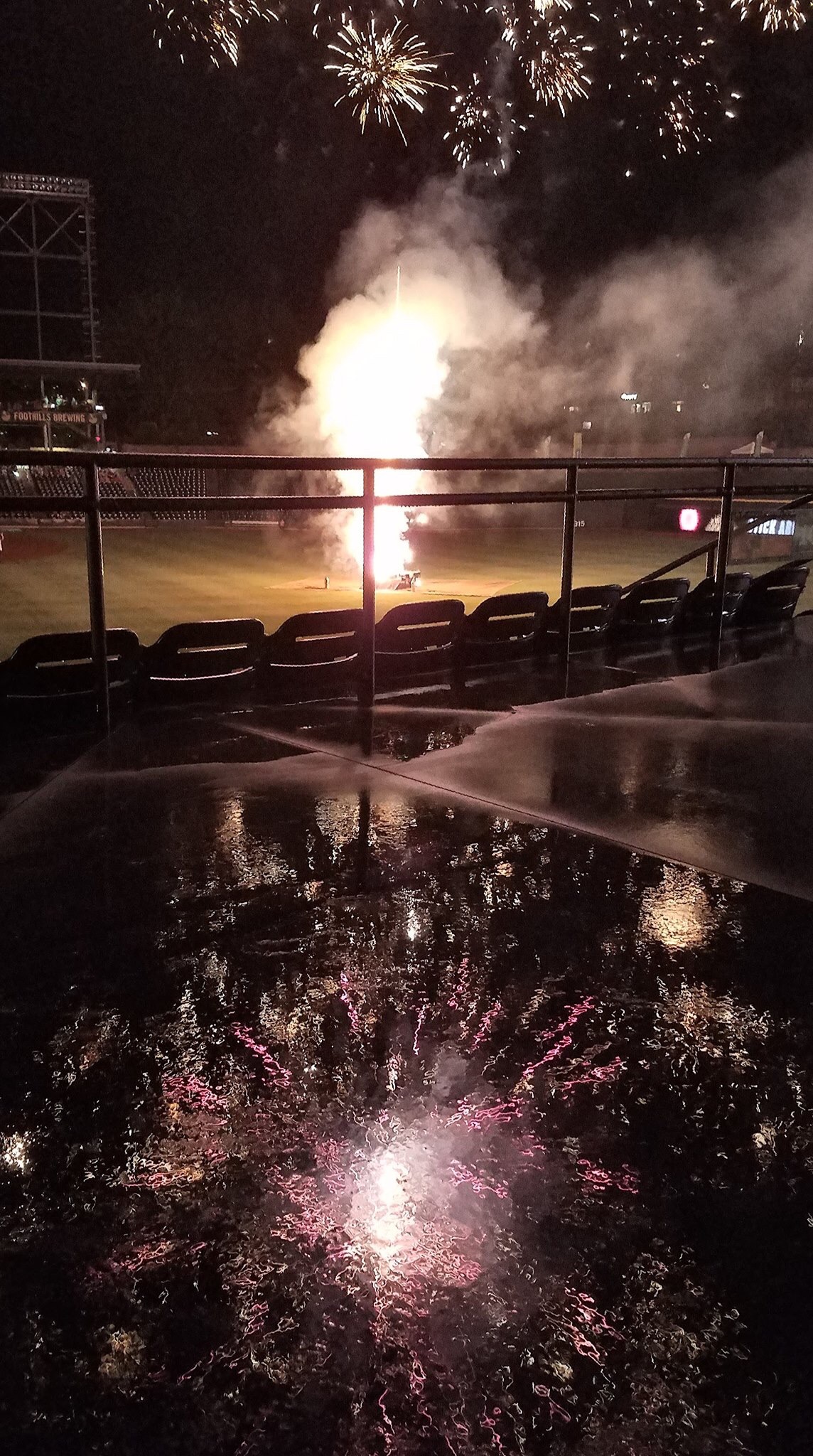
Photo by Sheila G. Hunter

This summer I went to quite a few minor league baseball games in my city. Friday nights are fireworks nights at the baseball park. One Friday night, I was walking to my car as the final fiery waterfall filled the evening sky. I stopped to watch, and as the glittering lights faded, I noticed behind the smoke the glow of a cluster of stars.

Fireworks can be breathtaking and awe-inspiring. Fireworks are also momentary. In our chaotic world, much of what we thought was reliable or certain has been shown at best to be fleeting and at worst to be undependable. Perhaps a stabilizing message I can express across my lifetime—including across my life as a writer—is the hopeful and mysterious promise of the stars.

So, another blog post ends. Tomorrow I will attempt to write again. And again the next day. My aspiration? To create a constellation of words, images, poems, and stories that offer a steady presence of wisdom-seeking in an uncertain world. And when I push “publish,” I will go out and try to embody the words I write.
the writing work of the people

crafting poems, prayers, and litanies for worship

What does worship sound like? What ideas, hopes, dreams, and laments do the words of worship spark or stir or set loose in our hearts and minds? What images of God swirl up out of our communal prayers and hymns to shape what we believe and who we are as people of faith? Words are powerful. How we use words in worship matters.

At Wake Forest University School of Divinity, I teach a course entitled “Liturgical Writing as Spiritual, Theological, and Prophetic Act.” One aim of the course is to encourage students to become liturgical writers, in other words to craft prayers, poems, spoken word pieces, hymn texts, blessings, calls to worship, and more. The course also invites students to explore and name what theologies they are embodying through their choices of language, images, styles, and forms for public prayers and written liturgies. In the course, students learn about elements of worship and explore historic and contemporary examples of how words and linguistic patterns are used in liturgies. Students also share their own liturgical writing efforts each week in a writers’ workshop format. My primary hopes for the course? I want students to explore relationships between the historic and traditional voices of diverse liturgical forms, their unique voices and theologies, and their roles as public prophets, theologians, and spiritual leaders. I also hope that students will attend to elements of style that support vivid and effective liturgical communication: rhythms of public prayer, use of metaphor and imagery, how form and language create atmosphere in worship.

Sometimes students are reluctant to “write liturgies.” In some cases, that is because they come from traditions where most liturgical elements are already crafted for them in denominational worship books or in other resources. Other students come from traditions where writing liturgies is not a common practice. I invite all students to experiment with liturgical writing as a spiritual discipline that can spark greater awareness of their personal theological beliefs. Liturgical writing can also instill confidence in students about the vitality of their public voices as they prepare to become worship leaders.

As students in the course take their initial forays into writing liturgical elements, I encourage them to consider what I call “place-connected” dimensions of worship. What do I mean by this? The most important thing we can do when we craft prayers, hymns, and litanies is to let our liturgies arise as we are fully present to our surroundings and to the story that is unfolding in front of us in our communities–in our places.

Sometimes students request templates to help them frame their written work. I tend to avoid using templates and instead offer students basic information and guidance about the shape and purpose of various worship elements. I want students to explore what it means to be fully present in a pastoral moment and then consider how to express what they experience through extemporaneous and written prayers and other liturgical forms.

The work of hospital chaplains provides an example of the place-connected prayerfulness I hope to encourage in pastoral leaders. Chaplains are often asked to pray at the bedsides of patients. To think theologically on my feet and shape a prayer that arises from the soul of the moment means, for me, noticing everything and every person in the room. Is there a stuffed animal in the room–where did it come from? Who is present? What stories are people telling? Is it winter outside or springtime? What is outside the window? Even the shoes people are wearing can sometimes tell you something about the narrative arc and emotional center of the praying moment.

Having connected with all that is present in the moment (including what is present in the chaplain’s own heart and body), then the chaplain can focus on an image or metaphor and allow a prayer to arise with that image at the center. I find that this gives prayers emotional color and weight that make them memorable and powerful.

Today’s ministry students and pastoral leaders encounter on a daily basis a wide array of multi-denominational and multicultural religious contexts. Ministers are often asked not only to lead in public worship but also to offer prayers for a range of situations and occasions (over family meals, at public events, and for varied ritual occasions, such as commencements, house blessings, and church dinners). As they explore historical and traditional liturgical forms and resources and attempt to craft some of their own worship words, students learn much about the dynamic and often prophetic relationship between what we pray and what we believe.

Note: In collaboration with students in two versions of this course, I have published collections of their liturgical writing. Words Made Flesh: Poems and Prayers for Worship and Uncommon Words, Common Worship; Selected Prayers, Poems, and Laments. Both were published by Wake Forest University’s Library Partners Press.