
Leadership, Artistry, and a “Sense of Place”

Like pipe organs, we learn to breathe in and with our communities. . .

I saw my neighbor, Dreama, at the community cafe this morning. Dreama is an organist. She teaches organ and provides music for Sunday worship at a local church. Dreama is an artist who is passionate about her art. Something she said about being an organist intrigues me.

“We organists are a peculiar group. We love our instrument—the organ—but we can’t take our favorite organ with us when we go out to share our work. We have particular organs we love to play, but we can only play them in the place where they live. Organs are not really transportable.”

Thank you, Dreama, for inviting me to think about how important it is that people in all professions pay careful attention to the places where we do our work. Having a “sense of place” is vital to the effectiveness of our professional endeavors. It is also vital to the life and health of the communities where we hang out our shingles, if you will, as artists, doctors, lawyers, teachers, ministers, and others.

What is a “sense of place”? Some people say a locale’s “sense of place” is shaped by the characteristics that make it unique from other locales. People are drawn to these characteristics and are connected to places over a lifetime because of experiences they have in them, whether good or bad. Communities cultivate a healthy “sense of place” when they instill in their residents an authentic sense of belonging. And an authentic sense of belonging can heal broken hearts, foster peace and inspire hope, and lead to overall communal well-being.

Dreama, as an organist, has had to cultivate an awareness of place as vital to her artistry. She plays organs in diverse locales. Each organ in each locale is unique, designed by a particular builder and then constructed, in part on site, to fit the architecture and acoustics and sometimes oddities of the space.

Author Agnes Armstrong specializes in the history of 19th Century organists and organ music. She writes that

in medieval times, a builder would move his workers and often his entire family to the site of his next organ. They might even take up residence inside the cathedral being built around them, sometimes for a year or more. There they would be devotedly occupied with building the organ. . .

Agnes Armstrong

Organs, especially pipe organs, become a part of a place’s architecture.

Organs also hold stories:

“I will never forget how I felt when I heard those first organ notes as I came down the aisle on my wedding day.”

A woman in a nursing home remembering her wedding

“I remember hearing all of Mama’s favorite pieces played on that organ for the prelude at her funeral.”

A family member’s recollection of a funeral service

Good organists develop their musical skills and expertise over their lifetimes. Amazing organists also attend to each organ’s peculiarity and to the stories, memories, and connections that are present when they sit down to accompany a choir or perform a concert.

Photo by Sheila G. Hunter, 2014.

I am grateful for the conversation with Dreama. She is an amazing organist. Her wisdom about her art reminded me to lean in to the places where I go as teacher, poet, and preacher to listen for all of the voices and stories that make a place what it is. The health and well-being of leaders and the communities we serve depends on a rich meeting or intermingling of our story and skills with the particular and peculiar stories, gifts, and challenges of the places where we serve.

Agnes Armstrong writes that “pipes in a newly constructed organ must ‘settle in’ and ‘make their own community’” within the space where they reside. We all do that when we bring our artistic and professional endeavors to a new place. Like pipe organs, we learn to breathe in and with our new communities, and in partnership with them to make music that is unique to us and that has the potential to make a difference in our world.

On Rekindling Your Passion

Some passions keep luring us back into their embrace. Or is it their clutches?

for writing (and other callings to creative work)

I wrote my first novel–well, started writing it–with my best friend in fifth grade, Sandra. Sandra and I lived in the same neighborhood and spent many days after school hanging out together.

We didn’t start out to write a novel on that afternoon when we came up with the idea. For a few days, we had been curious about a vacant house down the road from where Sandra lived. Of course, we didn’t know any facts about the house or its occupants. All we knew was that one day tricycles and a Buick were parked out front and the next day they were replaced by a “for sale” sign. Something sinister must have happened, we surmised.

Our imaginations took over from there. After several days of conjecture, we decided to write a mystery novel featuring the now empty house and its departed inhabitants.

I don’t remember why we chose to record our unsubstantiated theories about the house in a novel. Looking back, that seems like an odd undertaking for a couple of ten-year-olds.

Both of us were devoted fans of 1970s teenaged sleuths–Nancy Drew, the Hardy Boys, Alfred Hitchock’s three investigators. Our love of reading those mysteries may have inspired our own writing aspirations. We were also avid watchers of “Dark Shadows,” a soap opera that we found to be funny and scary all at the same time. The story we began to imagine about that house down the street was scary–and hilarious–to us. We giggled as much as we wrote as we huddled around the typewriter on those after school afternoons.

I am certain the novel was a success. That, too, is unsubstantiated if success is determined by the quality of the writing or the quantity of books sold. We did not sell or even show the novel to anyone, and I have no idea what happened to the draft we created.

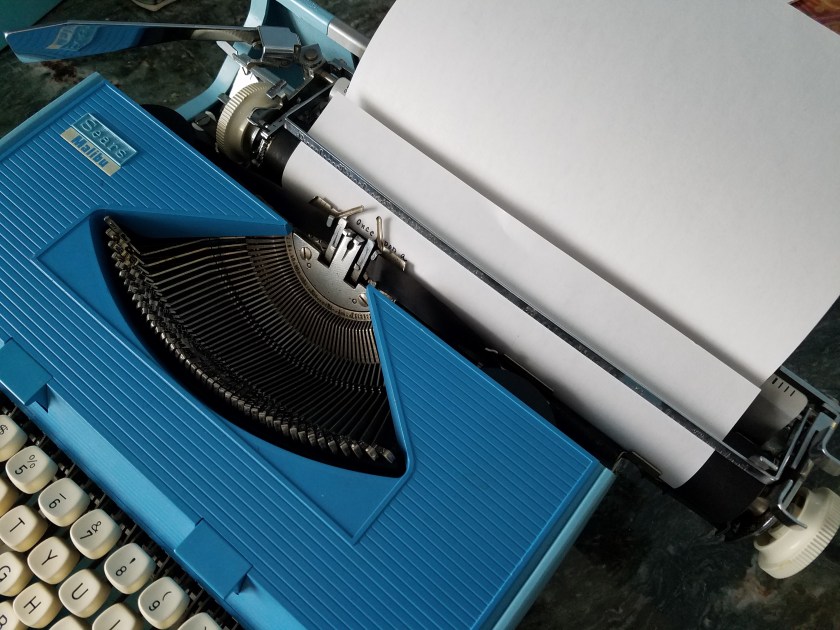
We typed our story on a portable Sears typewriter using typewriter paper we had cut to the size of novels we had checked out from the public library. Those typed sheafs of paper are long gone as is my memory of the plot and characters. Sandra might remember more than I do, but she and I lost touch over 40 years ago. I have a vague notion that she might be a pharmacist now–and maybe a writer, too?

Writing that novel ignited a passion within me. That is why I consider it a success. Ever since those afternoons of pounding out a plot on that manual typewriter on Sandra’s family’s carport I have loved to write.

In the years since I collaborated on that first mystery, I have written sermons, lectures, essays, academic books, blogs, poems, and stories. I have even co-written and published a full-length novel–Come Home Free–with a new writing partner, Sheila Hunter. None of my projects have made bestseller lists. Most of them have been read by only a handful of dedicated fans. Fame and fortune do not characterize my artistic endeavors. But over the years, I have continued to enjoy the writing craft and my identity as a writer. I love imagining myself to be a writer. I love being a writer.

On those days when my imagination has run dry or when I wonder if writing is worth the agony it causes (yes, writing is sweet agony most of the time), that debut novel that never debuted comes to mind. Or it should.

How can any of us rekindle our passion for creative work in the face of manuscript rejections, lack of readers, or just plain old loss of motivation? Three remedies come to mind.

First, we can take some time to remember what first sparked our artistic passions. One day after school Sandra and I jumped in and started writing a novel. We didn’t know how to do that or even have a good strategy for our efforts, but we had great fun spinning that fanciful yarn of ours. Those feelings of desire and enjoyment have never dissipated and have the power bring me back to the keyboard even on days when apathy threatens. Sometimes we need just to dive in and write.

Second, we can reignite our curiosity about the things we encounter in our everyday lives. We might even stoke our imaginations by observing and brainstorming with another artist or friend. I think such brainstorming sessions should always involve a certain amount of giggling.

Third, we can continue to create through the dry spells. It took me a long time to add “writer” to my resume. Through writing, I have developed my voice and gained clarity about what I believe and value. Writing connects me to other people and the world around me. Writing gives me space to follow paths that lead me away from emails and calendars. Sometimes I even write myself down unexpected trails where adventure lurks around the bend. I am a writer. Writers write. And writing itself can rekindle our passion.

I wish I still had a page or two of that childhood novel. I am curious about the voice and imagination of the ten-year-old me. I am also curious about what sort of tale Sandra and I decided to tell about that vacant house down the street. I am sad that those pages are gone. But a few manual typewriters are still around. The next time I hit a writing wilderness–when all else fails–maybe I will sit down at an old Sears and see follow whatever plot my fingers remember.

Photo by Jill Crainshaw