Honk if You Love Jesus (and Other Sacramental Pandemic Peculiarities)

Seeing your face is like seeing the face of God.

The sanctuary is empty, the parking lot full,
folks maneuvering pick ups and sedans
into back row spaces instead of back row pews,

just like Sunday morning—except

nothing is just like anything used to be. So
Pastor calls out from a flatbed trailer: “Honk
if you are glad to be in church today!”

And on a Wednesday night before a high holy
pandemic Palm Sunday procession,
worshipers hungry for a face, a word, a hug

fellowship through car windows,
then parade away into the evening,
a cacophony of horns blaring—

Chevy pick-ups and Honda Accords. Four-door sedans and all-wheel-drive hybrids. They all pulled into the church parking lot on Sunday morning. But instead of getting out of their vehicles to shake hands and offer hugs before going into the sanctuary, worshipers stayed in their cars. They waved to each other and waited. At 11am, the pastor pushed open the church’s front doors and headed out to the top step of the church entryway to offer a call to worship: “Honk if you are glad to be in church today!”

Drive-in worship

That is how “drive-in worship” was inaugurated at a small rural church in a neighboring county several weeks ago. Folks rolled down their windows or tuned into a special FM station so they could hear the pastor, and when they felt Spirit-inspired, they honked their “amens.”

A bumper sticker that’s been around for a long time—“Honk if you love Jesus”—has taken on a whole new meaning for worshipers in this community.

Journalist Lisa O’Donnell wrote about local drive-in church experiments in a Saturday Winston-Salem Journal article. The drive-in worship services O’Donnell describes are in Surry County and are examples of one way faith communities are trying to stay connected and vibrant during these pandemic days of social distancing.

Together while We Are Apart

Gathering to seek sacred wisdom for life and hope in the face of fear and uncertainty has become even more vital, it seems, to people who are spending long days alone or at least apart from their communities of work, worship, and play. In response, pastoral leaders are imagining unconventional ways to gather communities together for worship.

Without intending to, we are learning what it means to be the virtual Body of Christ (a topic ripe for additional conversation in a later post).

Virtual Signs of God-With-Us

Signs and symbols of God’s presence are central to worship practices in my Christian tradition. In recent weeks, unable to break actual bread together or pass the peace through literal hugs, people have sought out new ways to embody and share signs of God’s presence, love, and grace.

Some people are sewing face masks as a collaborative and communal project. Others are joining forces and finances to provide meals for school children. People are also sharing their musical and artistic gifts through an array of online sources. Some of my colleagues are surprised to discover that worshiping through social media platforms has even energized them and their communities.

In these uncertain days, many faith communities are finding their own unique ways to substitute honks for hallelujahs.

Seeing Your Face Is like Seeing the Face of God

I believe that God and faith in God can be found both in the most ordinary and the most mysterious dimensions of human spirits and everyday lives. I glimpse (and sometimes taste and touch) the shapes, textures, and colors of God’s life-giving mysteries when I worship with others who are also seeking faith and spiritual understanding. For now, COVID-19’s threat means we have to rely on visual and aural dimensions of Christian worship and human connection.

I am reminded of a story in Genesis. In this ancient story, Jacob crosses a river to meet his brother, Esau. Jacob fears this encounter because of the way he mistreated Esau in the past.

The scene of their meeting is powerful. Esau embraces Jacob with grace and love. Jacob responds:  “Seeing your face is like seeing the face of God.” 

In these uncertain days, being together as people of faith, even in unfamiliar ways, is important because of the hope and strength people find in seeing each other’s faces and hearing each other’s voices. Simple acts and gestures (index and forefinger in a V to pass the peace, emoji waving on Facebook live, honking an “amen”) remind us that God is with us, a belief that centers us and gives us hope.

And all God’s people honked an “Amen.”

Wild Hope in Wilderness Places

Wildness will find a way in the wilderness.

Never love a wild thing, Mr. Bell,’ Holly advised him. ‘That was Doc’s mistake. He was always lugging home wild things. A hawk with a hurt wing. One time it was a full-grown bobcat with a broken leg. But you can’t give your heart to a wild thing: the more you do, the stronger they get. Until they’re strong enough to run into the woods. Or fly up into a tree. Then a taller tree. Then the sky. That’s how you’ll end up, Mr. Bell. If you let yourself love a wild thing. You’ll end up looking at the sky.  

Truman Capote, Breakfast at Tiffany’s

Sheila and I vacationed one summer at an abandoned golf course. When the greens on every hole were shiny as polished emeralds, condos were built around the course’s perimeters. While golfing or sipping coffee on the condo screened porch, vacationers could watch seabirds dive into the inlet in search of their evening dinner. 

But the under-financed golf club didn’t make it, so when Sheila and I spent our vacation week there to be near the beach, we watched birds float on the wind over a golf course ghost town. 

koi subplots

I walked each morning along golf cart paths encroached upon by unruly grass. When I stopped on a bridge over a pond, I was greeted by 18-karat copper and gold koi that smiled up at me as I leaned on the wind-wearied rail. Their looping and circling subplot in the shadowy pond places of the golf course was uninterrupted by the drama of the club’s extinction. 

What I remember most about that vacation is that I imagined I was glimpsing the apocalypse. What else is a non-golfing theologian to think when seeing a sand rake positioned teeth up on the ground as though someone abandoned it mid-sweep. But the birds and bugs and beach grass and borrichia frutescens? They harbored no such apocalyptic thoughts. No, they claimed the sand traps and greens as a parousia playground. (Too much with the theological terms? I just can’t resist!) 

“In God’s wildness lies the hope of the world.”

John Muir

Hearing John Muir’s words, I can’t help but think about what we are experiencing during these quarantining days of abandoned businesses and bars and streets. The pandemic has stirred fear and uncertainty unlike anything most of us have known in our lifetimes. And it has altered our life rhythms, perhaps forever. I grieve the loss of life to this out-of-control virus, and I worry for those in our cities and towns who were already living on life’s most vulnerable edges. 

At the same time, I wonder if we might discover or rediscover the gifts of wildflowers springing up in desert places. 

crocus blooms in desert places

Isaiah 35 offers an image of wild hope to “those who are of a fearful heart.” Another way to translate the Hebrew phrase in Isaiah 35:4 is this: “those whose hearts are racing.”

We are those people today. Our hearts are racing, not just in a poetic or metaphorical sense, but literally. Some people’s bodies are wracked with COVID-19. Other people’s bodies are taut with fear and stress—maybe because we want to run away or perhaps because we long to keep running like we always have but can’t because we are suspended in time and space. 

Isaiah’s message echoes across the ages to us, an exiled and isolated people with racing hearts, quavering knees, and trembling hands. Isaiah’s message calls out into this current wilderness to us, to a people who are feeling sorrow and fear in our very bones. 

What is Isaiah’s word of hope? Wildflowers will shoulder up out of the hard dry ground of desert places. Wildness will find a way in the wilderness. 

rediscovering lost playgrounds

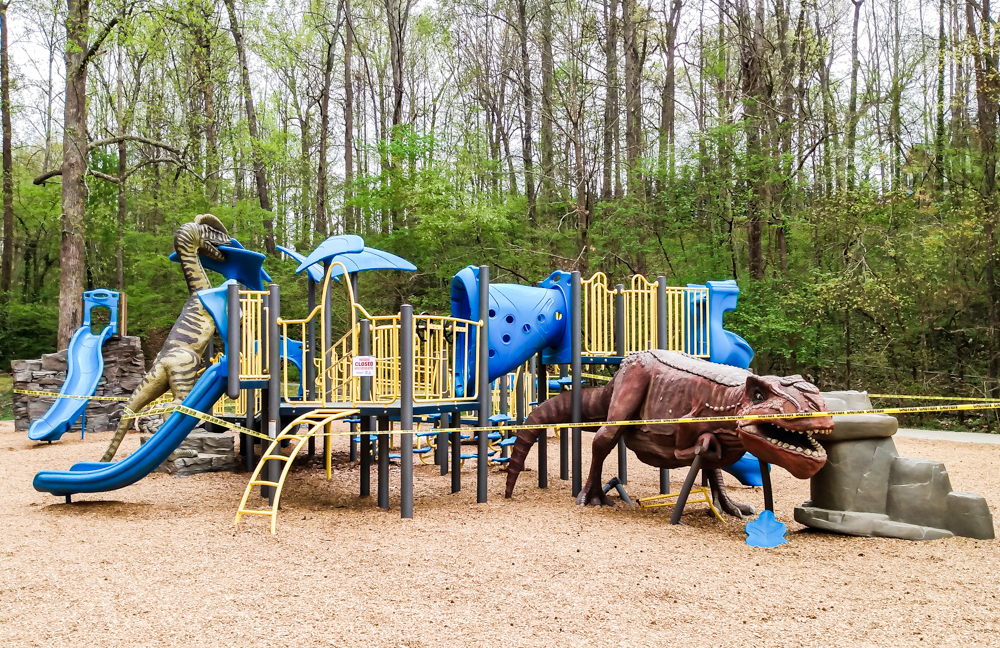
I walked through my neighborhood park a few days ago and was struck by a sad and peculiar sight. Our dinosaur playground–a kids’ space featuring a Tyrannosaurus rex slide and a Stegosauro climbing dome–was cordoned off by yellow caution tape and a sign that said “do not enter due to COVID-19 precautions.”

Our neighborhood children have laughed and played among extinct wild things, and they will again. 

In the meanwhile, I pray that in the midst of adrenaline-crazed days when hearts race while bodies are frozen in place, we encounter gifts of generous and restorative wildness sneaking back into our lives.

Maybe wildness will show up as we take more neighborhood walks and meet the pair of urban hawks who are nesting in that patch of woods by the park playground. Or perhaps wildness will adorn our backyard landscapes as weeds bloom alongside salads we plant in newly turned garden spaces.

And maybe–just maybe–the arrhythmia of these days will create an unexpected opening for creative and life-giving wildness to dance up out of the ashes of our own spirits. 

Seeking Wildness

“Come out, come out, wherever you are!”
I call to her–

Wildness.

She is a shy child, eager but afraid
to meet a new friend.

No, that’s not quite right–

She’s been leaning on the door all along?
Waiting–then stumbling into view

when the portal suddenly swings open?

“Come in, come in. I think we met
once upon a time ago”–

Wildness.

She is in me–sparrow and mockingbird,
wildflower and wilderness wanderer

Yes, that is it–maybe–

She is an uncertain season who beckons me
to a liturgy of her hours–

Wildness.

“Come on,” she says and reaches out.
“Let’s dance, just for a little while.”

I say “yes”–

unclenching my hands to take hers
while all creation sings a song called

Hope.