

Who Knew “Shoe Polish” Was So Beautiful? Savoring Teachers

What can we do to say “thank you” to teachers?

This week is National PTA’s Teacher Appreciation Week.

Today I am revisiting a blog I wrote several years ago as an ode of gratitude to teachers. My respect for those who teach our children has expanded and deepened in recent weeks as I see the work teachers are doing to support their students through the COVID-19 crisis.


“Shoe polish,” he said. “Listen to the words. Consonants and vowels feel and sound a certain way when you say them. ‘Shoe polish.’ Don’t you just love that sound?”

Mr. Rogers was my high school English teacher. He loved words and the artistic work of putting words together to make sentences. Mr. Rogers was also enamored of novelists who wove sentences together into tales in which memorable protagonists grappled with life’s deepest questions.

“Every one of you can write beautiful words, sentences, and stories,” Mr. Rogers said. “You can be writers and artists. You can change the world.”

I was sixteen years old. I wanted to believe him.

TEACHING HEROES SHAPING OUR CHILDREN

Political decisions in many cities and states have created complex challenges for public school teachers. In North Carolina, where I live, legislative actions over a number of years have decreased resources for public schools and teachers, and some schools face significant teacher shortages. Teachers are weary and discouraged. 

And yet, each year parents let their kindergarteners go into a world of public education, where their hearts and minds will be forever shaped by those who teach them about grammar and history, math and science, literature and art. 

Each day of the school year, teachers like Mr. Rogers stand in that boundary place between home and public life, and urge our communities’ children to read, write, create, and explore. They teach children how to be good citizens. They encourage them to care about what happens in our world. They have the power to open our children’s minds to the world and to open up worlds for our children. 

The hard, often thankless, work teachers do matters. They deserve our support. They deserve better legislative decision-making. They deserve gratitude.

WHAT CAN WE DO TO SAY “THANK YOU” TO TEACHERS

People of faith have important roles to play in improving the capacity of education to shape healthy and just communities. Joining other religious and public leaders in demanding legislative change is one vital way. 

Another way people of faith can impact what happens in schools is by embodying one of the faith’s most powerful gifts: gratitude. 

This year teachers are facing even more challenges than we or they could have imagined to teach our children. I am so thankful for teachers who have scrambled to learn technological innovations for teaching during this pandemic. Many teachers I know have been creative in how they have stay connected to their students, and have gone above and beyond to support those whose home situations are uncertain. Teachers are amazing. 

God’s expansive creativity inspired the buzz of the bumblebee and painted spring pansies lavender and orange. God’s expansive creativity breathed life and love into human souls. God’s expansive creativity birthed radical Gospel justice and grace. When we offer expansive generosity to others, we live out our “thank you” to God. We embody God’s own creative grace.
Mushroom Vision and the Dance of the River

Sometimes I can’t see what is right in front of me.

Then one of them, whose name was Cleopas, answered him, “Are you the only stranger in Jerusalem who does not know the things that have taken place there in these days?”

Luke 24

Sometimes I can’t see what is right in front of me. Are any of you like that?

Mushroom vision

Some friends in Virginia had spectacular mushroom vision. They loved to hunt for morel mushrooms that grow wild in the woods, and they could spot them too! This, in my experience, was no easy task. Morels are masterful camouflagers. Often when I ventured out on a mushroom hunt with friends? My shoe was on top of the mushroom before I was even aware I had “found” one.

Morel Mushrooms

Sometimes I can’t see what is right in front of me.

But other things that I don’t see? I think I miss them because my eyes are focused elsewhere. Or perhaps my mind is. Or my heart. Sometimes I am just not looking. Other times? My perspective is off kilter.

Now, morels can be hard to see. Part of their mystery is that they pop up in the woods almost overnight and blend in with the other foliage.

A stranger on the Emmaus Road

In Luke 24, some followers of Jesus are headed home from the city. They are probably traumatized by what they have experienced, the violence they have seen done to their friend. They have also heard the unbelievable news that maybe Jesus is no longer dead.

Their heads must have been spinning.

So they don’t see what is right in front of them. They don’t recognize Jesus as he walks with them along the road.

The story is a mystery. Scholars and others have pondered for years why Jesus—someone they knew before he died—now seems an out of touch stranger to them.

But, then, the one they knew—Jesus—was killed. To walk with him on the road was the last thing they expected. Their conversation and their hearts were mired in disappointment: “We had hoped. . .”

“We had hoped—“

This text holds many messages for us.

The one I hear today—during this Easter season—is this: Whatever our hopes were or are for our lives and for our communities, God is with us on the road, even when we can’t see or recognize God.

During these social-distancing days, I am noticing things around me I have overlooked before. The birds seem more abundant and full-throated than usual, the irises bolder and more loquacious. I have enjoyed creation’s abundant beauty.

And I pray that we—the collective communal we—gain a new perspective both on our community’s overlooked gifts and on our societal brokenness. Once those followers saw that it was Jesus, they were forever changed. May we, too, be changed by what we see and encounter in these days. And may our lives—our actions, attitudes, and practices—be transformed.

Fried morel mushrooms, by the way, are a delightful delicacy, if you can find them. Of course, you have to know something about what you are looking for; not all mushrooms result in gastric delights!

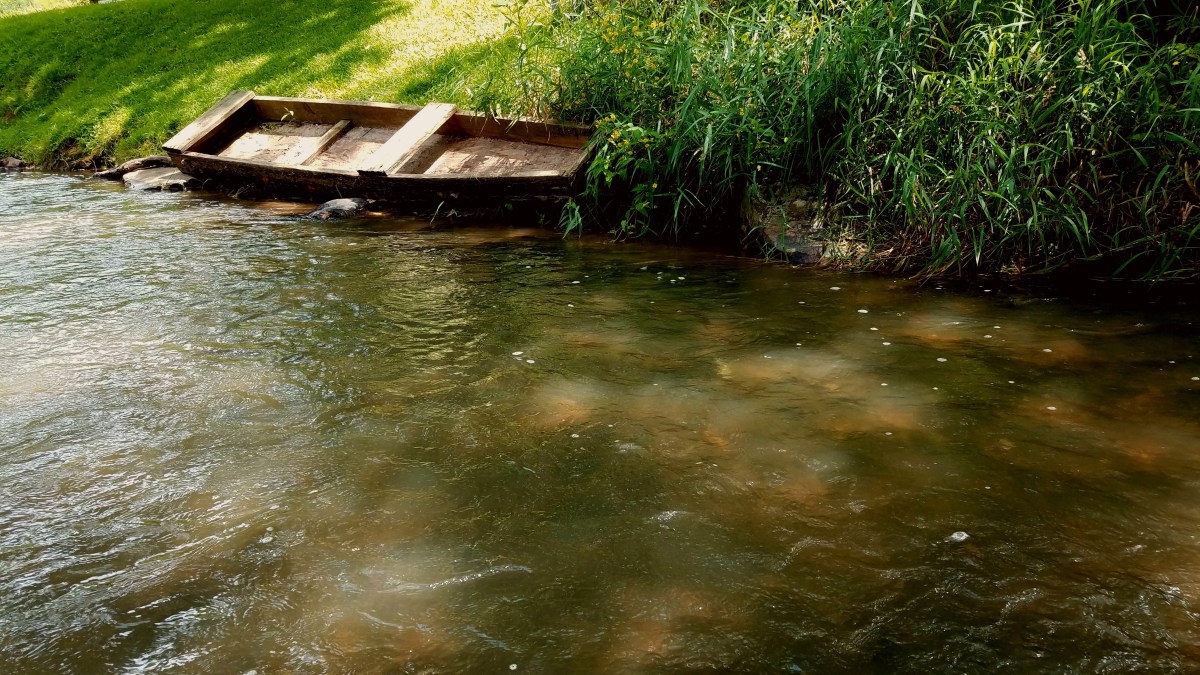
Ode to the river
down the road that
I am getting to know again
as if for the first time

It’s been too long, old friend,
since I last saw you dance—
not because you weren’t moving
but because my ears
were too full of distracting debris
to listen for your music.

Ancient rocks welcome your embrace.
Pebbles laugh in sun-touched delight
as you slip and slide across their backs.
And trees lean in close
to hear you whisper
the secrets rivers keep.

Thank you for continuing
to twist
tumble
turn
to the music of the spheres.

Thank you—
for saving a dance
for me.