
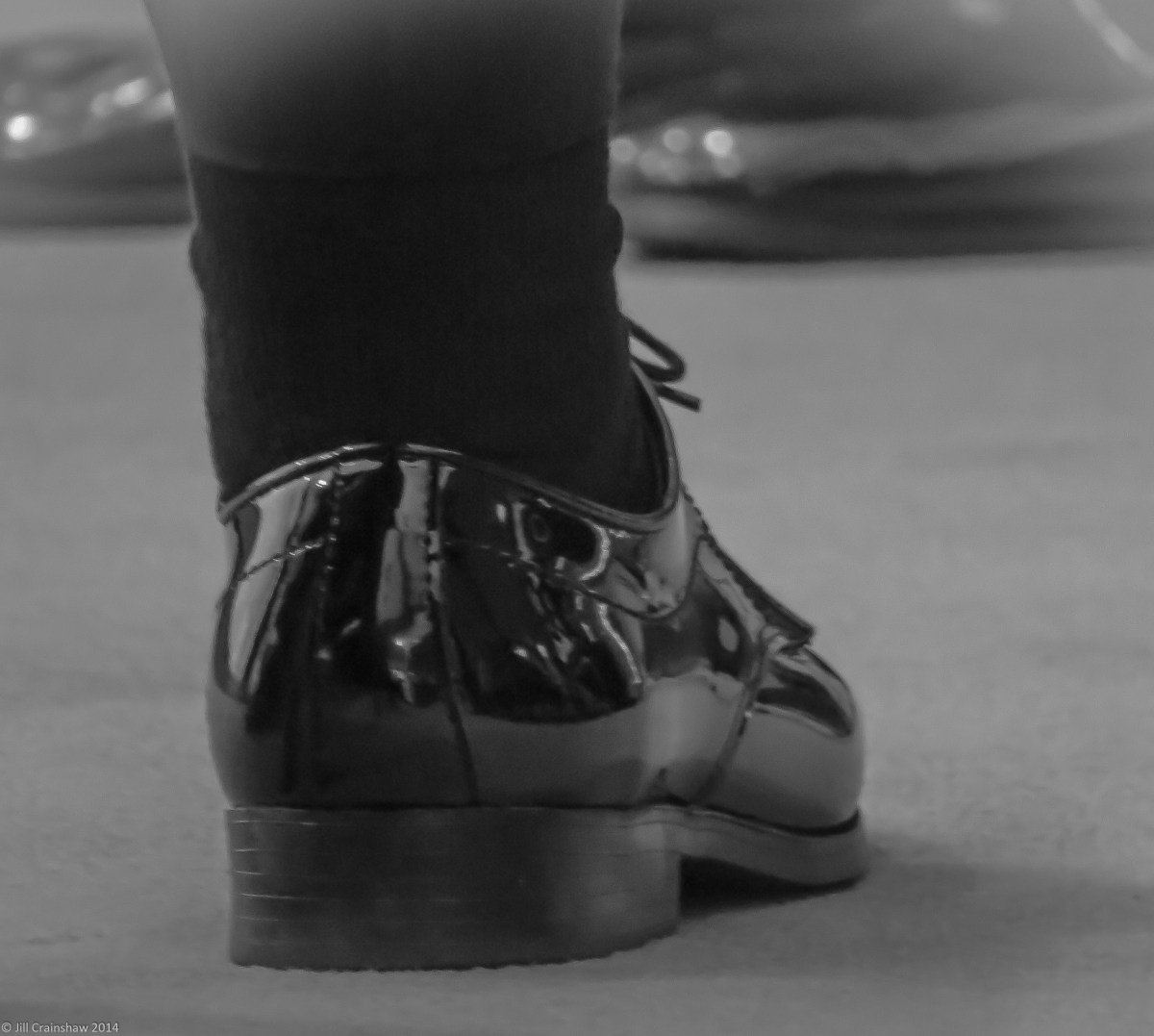
For “Shoe Polish,” I say, “Thank you”

“Shoe polish.”

“Listen to the words,” he said. “Consonants and vowels feel and sound a certain way when you say ‘Shoe polish.’ Don’t you just love that sound?”

Mr. Rogers was my high school English teacher. He loved words and the “wondrous poetry” of putting words together to make sentences. Mr. Rogers was also enamored of novelists who wove sentences together into tales in which memorable protagonists grappled with life’s deepest questions.

Joseph Conrad, Polish author who wrote in English, was one of Mr. Rogers’ favorites. I met him on the same day I met Mr. Rogers and leaned in to hear the vocal choreography of the vowels and consonants of “shoe polish.”

“Mr. Conrad was not a fluent English speaker until he was an adult,” Mr. Rogers said. He stood before us in a dark suit, white shirt and black tie, his daily teaching costume. “And yet he became one of the greatest novelists to ever craft a tale in the English language. When you read The Heart of Darkness, Conrad’s words carry you with him down the Congo River, and you grapple with what it means to be human in an indifferent and dangerous world. Joseph Conrad will be our teacher this year. Learn from him. Every one of you can write beautiful words, sentences, paragraphs and stories. You can be poets and novelists. You can be writers and artists. You can change the world.”

I wanted to believe him.

Mr. Rogers had a plan to turn us into insightful readers if not poetic writers. “Diagram these sentences,” he said. He gave us copies of the Declaration of Independence. “Learn what part each word plays in this historic declaring of freedom.”

Each day as he played jazz or Mozart on the piano in his classroom, we created on the blackboard visual schemes of sentences selected from great literary works. “Listen to the words,” Mr. Rogers said. “Pay attention to the architecture of the sentences. Words are powerful. They can bring great healing. They can also do great harm.” I was sixteen years old.

Mr. Rogers devoted his adult life to public high school teaching. Through Mr. Rogers’ voice, I heard words and stories at age sixteen in ways I had never before heard them. He taught me to see beauty and mystery in the most ordinary of things. He opened windows through which I looked for the first time at race and culture, human suffering and joy, my small town and our great big world. These were things my friends and I needed to wrestle with and respond to in the 1980s. These life realities still need our responses, and I have more than once found myself remembering Mr. Rogers as I walk into a classroom to teach worship to graduate ministry students who are eager to change the world and who need look for God’s beauty in the most ordinary stuff of water, bread, and wine in order to do so.

I grew up and live now in North Carolina. In recent years, political decisions have created complex challenges for teachers. Teacher’s salaries in North Carolina for 2015 rank 42nd in the nation. Legislative decisions have decreased overall resources for North Carolina public schools and teachers. And yet, each year mothers and fathers let their first-graders go into a world of public education where their hearts and minds will be forever shaped by those who teach them about gerunds and history, math and science, languages and art. Each day of the school year, teachers like Mr. Rogers stand in that boundary place between home and public life and urge our communities’ children to dream, write, create, and explore. What teachers do matters. They shape those who shape our world. They deserve our appreciation and support. They deserve better legislative decision-making.

I learned this week that Mr. Rogers is no longer alive. My love of words came alive while writing poetry to the sounds of his generous renderings of Chopin’s waltzes on his beloved piano. I hope that my writing, speaking and teaching over the years since then have been acts of gratitude to him. I wish I could have thanked him in person.

What I offer into the universe today as an ode of sorts to Mr. Rogers is this: I am 52 now. Just the other day I heard myself say to a friend, “Shoe polish. Don’t you just love how that sounds?” She tilted her head and raised her eyebrows. But I suspect she will never hear or think about ordinary old shoe polish in the same way ever again.

Thank you, Mr. Rogers.

In My Bones: Holy Week Reflections

Holy Week began a few days ago, on Palm Sunday. Many Christians processed into worship, colorful banners and streamers and emerald palm branches dancing in the air as they went.

I do not dance with ease or grace on any day. I stumble even more on Palm Sunday. My uncooperative sense of rhythm is only part of the problem. I process with awkward reluctance because my heart and mind are reluctant to grapple yet again with the seven days Christians have marked as Holy Week.

What makes this particular version of Sunday through Saturday holier than other weeks of Sundays through Saturdays? Judging by the headlines in this morning’s news, I think it is fair to say that human endeavors will not do much to create an ecology of particular or peculiar holiness during this week (though I suppose we can be on the look-out every week for those moments when human courage and faith ease or even transform some element of communal brokenness). How do our ritual actions during this week speak of God in and to communities crucified every day to appease the gods of commerce or politics? What do our 21st century embodiments of Jesus’ story mean in a world where disease or violence or war disrupt life and where too many of the wrong things and not enough of the right things are resurrected? These questions trouble my feet as I make my way in fits and starts along well-traveled Holy Week pathways.

But I am a liturgical theologian. So when my heart and head have no insight or energy with which to reckon with what Christian theology speaks, means or accomplishes, my bones take over. I do not understand the physiology or spirituality of why it is the case, but I am somehow able to believe in my bones that something about what we embody in Christian worship connects us to the on-the-ground realities of our neighborhoods and communities. And something about what we embody as community in Christian worship connects us to God’s Spirit.

For me, worship—communal ritual practices—keep our feet on the ground when our thoughts roam without direction through complex ambiguities and when our feelings ebb and flow without rhyme or reason. When we cannot embrace the barest bones of belief, our physical bones incarnate, carry out and do as best they can what we understand God to be in the midst of suffering. When in spite of our lack of rhythm, we decide to keep on stumbling together along potholed Holy Week pathways and let those pathways take us to streets where people are hungry or into neighborhoods where people have been forgotten, ignored or cast out, then we at least stumble together on holy ground.

A Jesuit theologian, Agbonkhianmeghe Orobator, is helping me to limp with more grace through Holy Week this year. Orobator writes that in the midst of the “flawed words and stubborn sounds” of our worship practices, there remains a prophetic and graced Word. What we do during this week is more than theological abstraction or ritual legalism. What we do during this week is more than scripted rhetoric about Jesus’ crucified body and our redemption.

During Holy Week, we break bread on Maundy Thursday and lean with longing into the silence of a Friday that is anything but good. In that silence, says Orobator, in those moments when Jesus cries out to a God who does not answer, another holy Word is spoken. What Word? The Word that speaks in the lives of unacknowledged, marginalized, and ignored prophets who in their work in their cities and neighborhoods “show the ‘face of redemption turned visibly’ toward the sick, the poor, the refugees.” These ones absent from word-centered religious, political and economic institutional arenas? They are sacraments of God’s saving presence with God’s people. They believe with their bones—with their beaten down backbones, their arthritic fingers, and their road weary feet—and in their believing they incarnate in despairing places the promises of God’s grace and love. By remembering and acknowledging their presence, we remember Jesus.

I drove past a local church this past Sunday on my way to my own church’s Palm Sunday celebration. Their triumphal entry was under way. I looked, and then I looked again. Two women, one in a wheelchair and the other using a walker, waved palm branches in the air as others helped them down the sidewalk and into the sanctuary. At my church? We remembered Jesus’ triumphal entry into Jerusalem and then heard in word and music the story of Jesus’ passion, Jesus’ suffering. The choir sang the haunting laments of the season—“O Sacred Head Now Wounded,” “Were You There When They Crucified My Lord?” “Beneath the Cross of Jesus.” The pastor spoke about Jesus’ pain-wracked and broken body. The sacramental irony? I sat in worship just inches away from our community’s newest member, an infant a mere four weeks into this beautiful, joyful, terrifying thing we call human living. As those mournful songs washed over us, that infant yawned, slept, stretched, kicked the air with tiny feet, gurgled, and cooed.

They grounded me again on Palm Sunday, those aging ones who we too often forget and that tiny one who so needs our care. And as I waved my palm branch and smiled at that sleeping child, I felt it in my bones, the tingling presence of Holy Week’s absent One.

So, I will do it one more time, limp through Holy Week, and be glad that my bones, though reluctant and aching as they make the journey, ground me. I pray that they take me, by the power of the Spirit, to the same kinds of human communities where Jesus’ own bones took him.